
There is no such thing as the perfect pallet, but there is an optimised one. Here is some useful information on how to choose the right pallet for your business.
This decision is not easy – it involves various costs, investments and other significant expenses. That is why in this article we will discuss each type of pallet in detail and which one would suit your business. Here is how to choose the right pallet for your business!
First of all: what affects the price of pallets?
Since price is what our customers ask about most often, we have made a price calculator available on our website moutardi.ro. The price can be influenced by:
- Pallet quality
- Quantity required
- Payment terms
- How long you have been our customer
- Wood species and log quality
Types of pallets available from us, the Moutardi pallet factory:
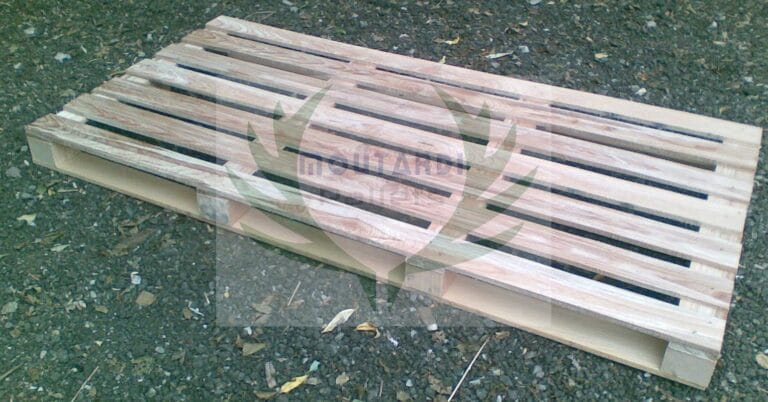
These pallets are the typical ones and are often called “standard pallets”, although it is slightly inaccurate to say a pallet is standard – it depends on each customer’s needs. We all know that industries are diverse and wide-ranging, and transport logistics adapts to demand.
They are perfect for the following industries/types of customers, among others:
- The food and beverage industry (companies producing and distributing food such as canned goods, fresh produce, juices, etc.)
- Retail (supermarkets, warehouses, etc.)
- Manufacturing (car, electronics, textile and furniture factories – mainly for transporting raw materials. Two examples of customers in this sector: a company selling car tyres and a sheet-metal plant.)
- Logistics and transport
- Agriculture
- Construction
From large companies and multinationals to small businesses and SMEs, as well as wholesale distributors and others, most of our customers choose this type of pallet.
This type of pallet is similar to the one above, but wider. This gives it several advantages for larger goods, and it is often found in the chemical industry or in manufacturing (car, electronics, textile and furniture factories – mainly for transporting raw materials. Two examples of customers in this sector: a company selling car tyres and a sheet-metal plant).
Here is some useful information about this type of pallet:
- It can be produced as a one-way/light pallet, just like the 1200×800 one
- It can also be produced as a returnable pallet, with a high load capacity of up to 3 tonnes.
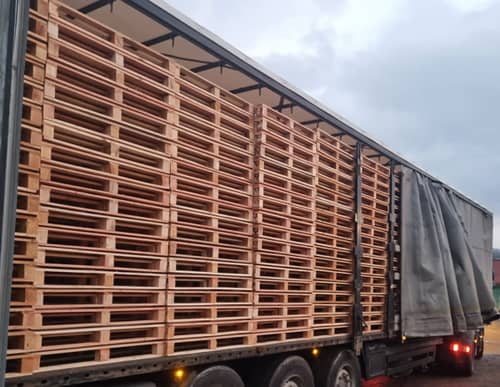
- On a truck with a 13.6 m semi-trailer you can load:
- 26 pallets of goods in one layer
- 52 pallets in two layers
- 78 pallets in three layers
When stacked in several layers, they can also act as load separators, playing the role of pallet lids, battens or wooden bars.
Here is everything you need to know about this type of pallet:
- It is also called a half pallet
- It is used for storing/transporting light, small goods. Examples:
- Drinks (soft drink cans, beer, water, wine, sports drinks, etc.)
- Packaged food (canned goods, pasta, snacks, sweets)
- Pet food
- Hygiene and cleaning products
- Cosmetics and personal care products
- Pharmaceutical products
- Office supplies and stationery
This type of pallet is versatile; its advantages are easy handling in tight spaces and the possibility of creating mixed loads to fulfil smaller/varied orders.
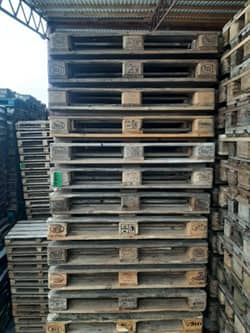
Euro pallets are sturdier and reusable. In general, they are in high demand among logistics and transport companies, manufacturers, distributors, retailers and farmers. They can be produced in several sizes:
- Euro pallet EUR 1 – 800x1200x144 mm
- Euro pallet EUR 2 – 1200x1000x162 mm
- Euro pallet EUR 3 – 1200x1000x144 mm
- Euro pallet EUR 6 – 800x600x144 mm
- Euro pallet EUR 7 – 800×600 (with Düsseldorf-type blocks)
- EPAL CP pallets (CP1-CP9)
How do you know you need Euro pallets? Simple: if the recipient of the goods requires the pallet to be stamped EUR/EPAL and/or licensed. If this is not required, all you need to do is some calculations to work out the cost per use, which makes it easier to choose between a non-EUR pallet and a Euro pallet.
Good to know: the only disadvantage is that Euro pallets require a very large amount of wood to manufacture. So if you do not need Euro pallets and want to be more eco-friendly, this information becomes relevant. You can also opt for second-hand Euro pallets if you need them.
Other types of pallets available, which we will discuss next time:
- Perimeter-base pallets
- Non-standard (custom) pallets
- One-way pallets
- Plastic pallets
- Pallet lids
With all this said, we hope we have laid a useful foundation for new and future entrepreneurs. Logistics is a complex field and choosing pallets can be quite difficult. We are always at your disposal, so do not hesitate to contact us for more details!