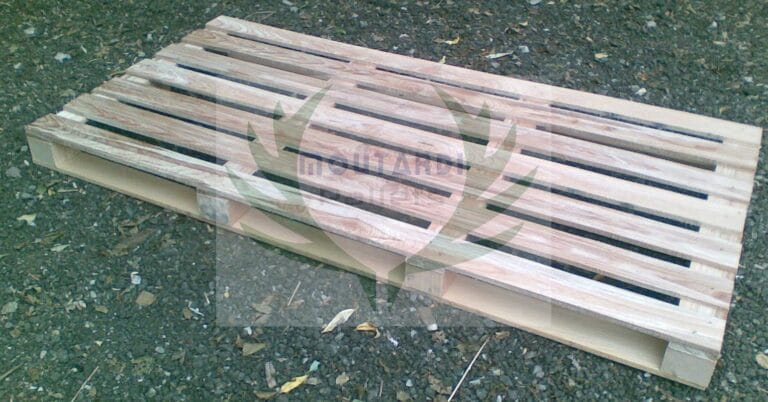
 First of all, anyone who wants to build furniture from pallets (or Euro pallets) should keep in mind that pallet components are the result of primary sawing, which means pallets are made of rough, unfinished, unplaned timber and may have splinters, uneven surfaces, saw marks, visible or partly visible knots, boards with holes, rough corners and so on.
Unlike the furniture industry, where secondary (fine) sawing is used, the pallet industry uses primary sawing, because pallets do not need finished wood like furniture does: their purpose is to store and transport goods safely, not to look good or have a high-quality finish.
So if you want to assemble beautiful furniture from new pallets or second-hand ones, we suggest using the tools needed to plane the wood. Wood-planing tools can usually be found in specialised shops or in the tool section of DIY stores, both for sale and, very often, for rent.
Also, some pallets have chamfered (cut) corners while others do not. For pallet furniture we advise you to chamfer the corners: you will get furniture that is “less painful”, kinder to clothes and shoes (which can get damaged by catching on or bumping into those corners) and also better looking – those of us in the industry can assure you that pallets with chamfered corners look much better than those without.
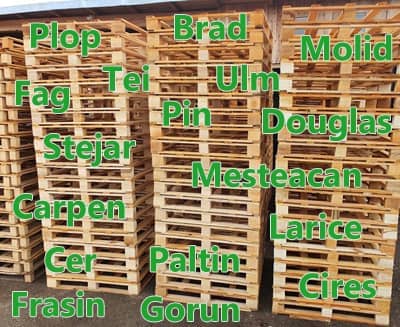
Another important aspect is whether or not to paint pallets for furniture. Here things are fairly simple, and this is our opinion: if the pallets are new or almost new, the wood is sound and good-looking, and the pallets are made of hardwood (beech, oak, maple, birch, Turkey oak, etc.), we recommend varnishing them. This way you keep the natural look and beauty of the raw wood, the pallets keep their originality and the pallet furniture will have a luxurious, high-quality feel.
If the pallets are older (greyish or even black), the wood is of poorer quality, or it is softwood – conifers (fir, pine, spruce, etc.), linden, poplar and so on – we recommend painting the pallets, and as most people already know, the best colour for pallet furniture is white. The most spectacular results can only be achieved by painting the pallets white. Whatever other colour you use, choose it carefully and as light as possible, so that you do not risk ending up with a disaster – money and time lost and a lot of disappointment.
Pallets or Euro pallets for furniture?
Of course, when we intend to make pallet furniture, we also think about what kind of pallets to use.
In Romania there is an abundance of pallets in two general categories: standard pallets (or, as they are called in the industry, “non-EUR pallets”) and Euro pallets. In our view, Euro pallets are the most suitable for pallet furniture because:
- they are standardised – so their components are cut with greater precision.
- they are very sturdy – the nails used for Euro pallets are standardised and of superior quality, and the standardised assembly method also gives them greater durability over time.
- they are of higher quality than non-EUR pallets
- they will last longer
We do not recommend making furniture from pallets that are:
– very old (blackened): no matter how much “heart” and skill you put into it, the furniture will not look as good as it would if you made it from new (or newer) pallets with the same amount of heart and skill. Blackened pallets also mean very, very old pallets, so by using them you would create furniture with more than half of its life already “expired”. Why would you do that?
– made with very poor-quality boards: in the world of pallets too there are better and weaker pallets. Choose the best you can find, i.e. without boards with knots, mould, pests or insect holes, and without badly cut boards: wavy, trapezoidal or wedge-shaped (thicker at one end and thinner at the other).
– with protruding nails: careful! Even if you hammer them back in, once nails have started to come out they will most likely come out again, and such a pallet is fit for scrap, not for furniture. Keep in mind too that a pallet with protruding nails may be out of square, unstable and therefore unsafe. If you still insist on making furniture from such pallets, we recommend driving new nails into the pallet and then removing the ones that have started to come out. This is a good solution, but only up to a point, because pallets are usually assembled with ringed or twisted nails driven by pneumatic nailers, which come out of the wood much harder than smooth nails, while you will probably hammer in smooth nails by hand. A pneumatic nailer also sinks the nails 2-3 mm into the wood, which is impossible with a hand hammer, where the nails stay flush with the board surface and are quite likely to catch on things later. In other words, a pallet assembled with ringed nails is one thing, and a pallet “patched up” by you is something else entirely.
– made of poplar: poplar logs are often used in the pallet industry. This wood is fine for carrying goods, but we do not recommend it at all for pallet furniture. As we know, shops sell furniture made of almost every type of wood, but you never find poplar furniture, because poplar is a very low-quality wood, heavily saturated with water, not very durable, easily warping or bending and quite elastic, so it is in no way suitable for furniture, even pallet furniture. How do you recognise poplar pallets? The easiest way is by smell, if you know it, or visually, if you know what poplar looks like (careful: poplar can be white, yellow or even brown, as there are dozens of species: white poplar, aspen, Euramerican poplar, etc.). Finally, to be sure, you can use a search engine to find photos of this wood and determine whether or not the pallets are made of poplar.