 We know very well that the most important factor when deciding to buy pallets or Euro pallets is, more often than not, the price. Decision-makers focus on the price of pallets / price of Euro pallets for the simple reason that their own goods face competition too, and in order to compete those goods must be as cheap as possible. Packaging is an integral part of the goods, so it too must be as cheap as possible and offer an excellent price/quality ratio.
One of the best options for companies looking for cheap pallets and cheap Euro pallets is certainly to turn to second-hand (SH) pallets or Euro pallets, also called used or pre-owned pallets.
As for the similarities between second-hand pallets and second-hand Euro pallets, in both cases they come on the market in two forms:
Quality of second-hand pallets / Euro pallets:
 Grade I or A: light-coloured, used once or a few times.
- Grade II or B: grey or black, used many or very many times.
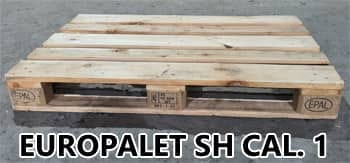 Grade I or A: light-coloured, used once or a few times.
Grade A is usually chosen by companies that care more about the appearance of their goods together with the pallet or Euro pallet underneath, even if this quality level costs more.
Grade B is chosen by companies that care less about appearance, where price comes first.
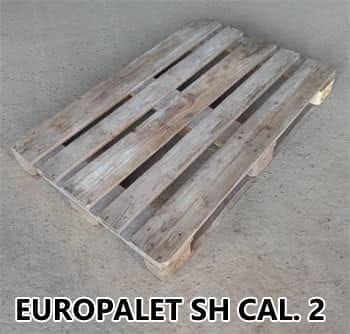 Very often, with grade B, the pallets/Euro pallets are not recovered, whereas with grade A customers in most cases recover and reuse the pallets or Euro pallets several times.
Another important aspect of grade A or B concerns possible defects caused by previous use. Since they have already been used, in both cases a certain number of Euro pallets will have defects. The difference is that with grade A these defects are very rare and easy to repair, while with grade B defects appear much more often, are bigger and harder to fix, and there is a risk that some of the Euro pallets cannot be used at all because the defects are too serious for repairs to be worthwhile.
In terms of price, there are big differences between Euro pallets and standard pallets: for Euro pallets the price drops much less from new to second-hand than for standard pallets.
Here are some details.
Second-hand Euro pallet prices:
 Since Euro pallets are reused many times, their value drops very little from the price of a new Euro pallet to that of a second-hand one, namely:
- for grade A second-hand Euro pallets the price is usually 15-20% lower
- while for grade B second-hand Euro pallets the price is usually 25-30% lower
Of course, depending on the case or in particular situations, prices can be lower or higher than average – for example, used grade A Euro pallets that have been used only once will certainly cost just 5-10% less, while, on the other hand, used grade B Euro pallets in very poor condition that need a lot of repairs may sell for 20-30% of the market value of new ones.
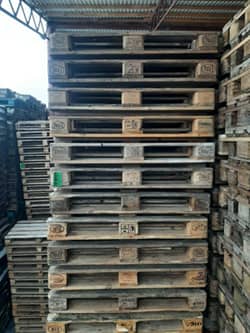
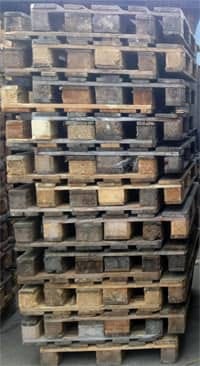
In the picture on the right you can see a stack of very worn grade B second-hand Euro pallets. Second-hand Euro pallets like these have a very low resale value.
Second-hand pallet prices:
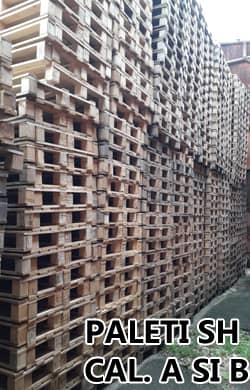 Unlike Euro pallets, standard pallets – or non-EUR pallets, as they are also called – lose much more of their value even after their first use, because Euro pallets are all identical and built to a single standard, whereas standard pallets are in most cases customised to the exact needs of each customer. So for standard pallets, the companies that collect them from the market have dozens of types of non-EUR pallets, because these pallets can have both standard dimensions and custom dimensions. Even when they have standard dimensions (say 1200×800), the pallet components may differ: company X may use 800×1200 pallets with boards 10 cm wide and 22 mm thick (because it puts heavy goods on them), while company Y may also use 1200×800 pallets but with boards 8 cm wide and 13 mm thick (because it puts light goods on them). So a company that collects standard pallets may have, for example, 5,000 pallets of the 800×1200 size in stock, but if those 5,000 pallets were collected from 5 companies, they are in fact 5 different types of 800×1200 pallets.
Companies that buy second-hand non-EUR pallets are usually able to put goods on any kind of pallet of any size. Because these pallets are very, very cheap, they “convince” some companies not to adopt one, two or three specific sizes (say 800×1200 and 1000×1200 for large goods and 800×600 pallets for small goods), but to put their goods on any kind of pallet they can find on the market, adapting their own logistics to be very flexible and independent of any standardisation on a particular pallet type or a few exact types.
Other companies adopt one standard, say a 1000×1200 pallet, and accept only this second-hand pallet, whether it comes with wider and thicker or narrower and thinner boards, as long as the overall size is 1000×1200 and the pallets are very cheap.
In most cases, even after their first use, standard-size pallets lose up to 30% of their value and custom pallets around 50%. If these pallets are grade B, standard pallets can drop below 50% of their original price, while custom ones may keep only 20-30% of their original value.
Disadvantages of second-hand pallets and Euro pallets:
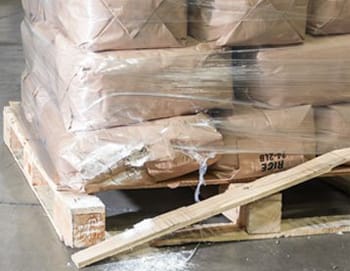 The big problem with second-hand pallets and Euro pallets is that there is a very good chance that even after the first use (let alone after many uses) they already have defects such as:
- cracked boards or blocks (which may break completely during the next use);
- broken boards or blocks that no longer guarantee the safety of the goods or of the operators;
- missing boards or blocks (which make the pallet or Euro pallet completely unusable);
- protruding or broken nails that can damage the goods or injure operators.
and many others.
Companies that both collect and refurbish pallets or Euro pallets are very rare. Most of them simply collect them and resell them with all their defects. And even companies that do refurbish them usually rely on human operators to inspect defects (3D defect scanners are rarely if ever used), and operators sometimes miss certain defects, so there is no 100% guarantee that the pallets are compliant and do not endanger the goods or the people who handle or transport them. This is also why most companies generally prefer new pallets to second-hand ones.