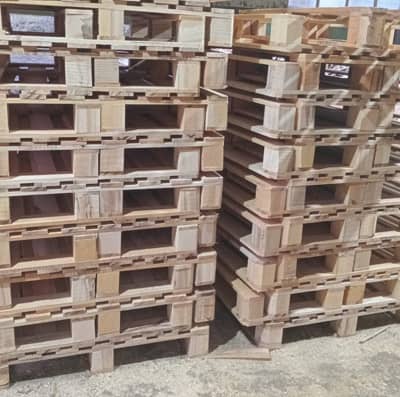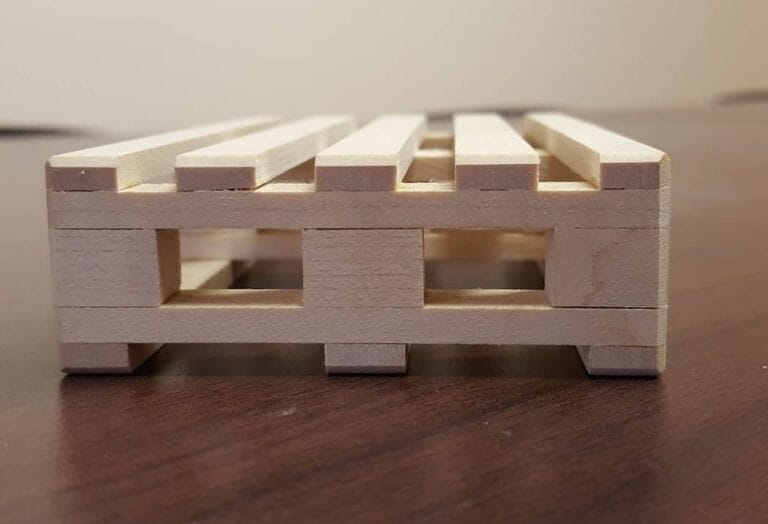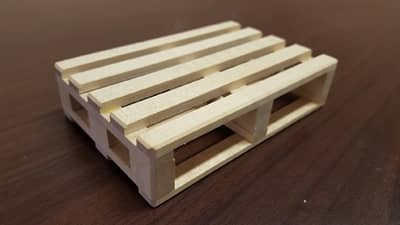

Although they may seem insignificant, pallets have played – and still play – a particularly important role in the history of the global economy.
From the early 20th century, as the world economy began to grow ever faster, industrialisation intensified, goods began to be produced much more quickly and in much larger quantities, and the exchange of goods between countries worldwide increased, people looked for a simple, efficient and cheap way to pack, store and transport goods.
These pallets (or Euro pallets) that we see today in shops and warehouses, loaded with the goods we enjoy every day, may seem unimportant, but it has perhaps never crossed our minds that these “unimportant” pallets have made a serious contribution to the prosperity we enjoy today, with better, cheaper products, sometimes brought from the other side of the world. We will also see that these same unimportant pallets gave the Allies a major advantage in winning the Second World War, as we will see in this article on “The history of wooden pallets”.
Today, pallets are used by manufacturing companies:
- to store or handle goods in warehouses until actual delivery
- to transport goods by any means of transport – road, sea or air
- to display goods for sale or presentation in shops or at exhibitions
and more recently, both companies and individuals have started using wooden pallets to create pallet furniture.
Today we enjoy powerful, fast and efficient production processes that result in much cheaper goods, which people enjoy every day. We can say that we have a strong global economy – and without the invention of the pallet, this global economy could practically not have got this far from a logistics point of view.
Since the earliest times, people have used wood in the form of barrels, crates or chests to store and transport various goods. The history of pallets, however, began after 1920, when factories started using wooden runners with boards nailed across them, on which manufactured goods were stored. Even today, these more “primitive” pallets, made of two or three wooden runners with boards nailed on top, are still used in factories, especially in the building materials sector, because this type of pallet is very quick and easy to build, uses less wood and is therefore very cheap.
The invention and use of pallets after 1920 was closely linked to the invention of the forklift in 1915, when the use of an automated machine able to carry and move goods both horizontally and vertically was first recorded in an American factory. The first forklift had no forks but a platform onto which goods were loaded and unloaded by hand. This machine could only carry goods or move them horizontally or vertically; its big disadvantage was that the goods had to be lifted on and off by hand by one or more workers.
The same factory therefore began looking for ways to pick up and set down goods without the need for other workers. The aim was for a single worker, using that newly invented machine, to handle the goods alone. This was when it was decided to replace the platform on the newly invented lift truck with forks. The invention of the forklift also meant creating the first pallet on runners, so that the machine could slide its forks between the runners and under the boards – and therefore under the goods – and lift them without other workers having to load the goods onto the truck, as was the case with the first lift truck. This is how the first pallet came into being: from the need to eliminate manual labour in handling goods in factories and to replace it with easier, faster and cheaper handling by machine.
In 1925, boards were also added to the underside (the bottom deck) of the runner pallet, giving rise to the modern pallet, which would go on to revolutionise the way goods are packed, stored, transported and protected from the moment they are produced until they are used. The boards on the bottom deck led to the concept of “stacking”, which allowed goods to be moved, stored and stacked with extraordinary speed, efficiency and ease.
This happened long before the world’s major warehouses began to rely on these simple wooden structures – later called “pallets” – to unload, store and load their enormous quantities of goods.
It was only around 1940, out of the need for greater manoeuvrability, that the four-way entry pallet was developed. To achieve this, the runners (legs) of the pallet had to be notched in two places where the forklift forks could enter, making it possible to handle the pallet from all four sides.
The invention of four-way pallets coincided with the start of the Second World War, a period in which the American economy threw itself into a colossal effort to supply both its own army and its allies. Realising that winning the war would also require a strong logistics process, and that enormous quantities of armaments, goods and supplies would have to be loaded and unloaded quickly and as efficiently as possible, the Allied countries agreed on a single pallet size, 48×48 inches (1219×1219 mm), as a unique, standardised pallet used by all Allied countries in logistics within and between them.
So it was during the Second World War that the concept of standardised pallets appeared, along with the practice of recovering and reusing pallets several times. In 1941, when the USA entered the war, pallet production was still in its infancy, at a pioneering and testing stage.
During the war, however, the standardised pallet began to play a key role in the army’s military logistics strategy, and its use created serious advantages for that strategy. By the end of the war, the tens of thousands of small and medium-sized companies involved in supporting the American army and its allies were using around 25,000 forklifts designed to work with the standard 48×48-inch pallet. Along with the mass production of forklifts for these companies, the mass production of pallets by specialised factories also began. The 48×48-inch pallet is still used today by the American army (alongside other standard pallets adopted since).